How To Do Assisted Pullups: 5 Easiest Exercises
Contents
Looking for assisted pullups you can do at home? First, it helps to understand the pullup itself. A pullup is a challenging upper-body exercise that builds strength in your back and arms. It is a staple of strength training.
Assisted PullUps
A full pullup is hard for most people because you have to lift your entire body weight. That is where assisted pullups come in. You can get help from resistance bands, an assisted pullup machine, a partner, or a chair.
There are several types of assisted pullups, each a small variation on the main move. For example, you can use bands, have a partner assist you, or push off a chair.
How To Do Assisted Pullups?
There are many ways to do assisted pullups, but here are 5 of the easiest. Let’s have a look.
1. Assisted Pullups By Band
If you are new to pullups, this exercise helps you learn good form while building strength and stability.
Start with a band that gives you plenty of help, usually a thicker, higher-tension band. As you get stronger, switch to a lighter band that gives less help.
Steps To Follow:
- Loop a resistance band around the bar to create a hanging loop.
- Grip the pull-up bar with your hands slightly wider than your shoulders.
- Place one or both knees or feet in the band.
- Start hanging with your arms straight.
- Pull yourself up until your chin clears the bar, or as high as you can.
- Slowly lower back to the starting position.
2. Reverse Pull-Up
This variation, also called a negative or eccentric pullup, builds grip and back strength by focusing on the lowering phase. As you get used to it, take longer to lower yourself. A slower descent makes the exercise harder and builds more strength.
Steps To Follow:
- Stand on a step or box under the bar, or jump up, so your chin is just above the bar.
- Hold the top position briefly.
- Lower yourself slowly and under control until your arms are fully straight.
3. Assisted Pullups By Partner
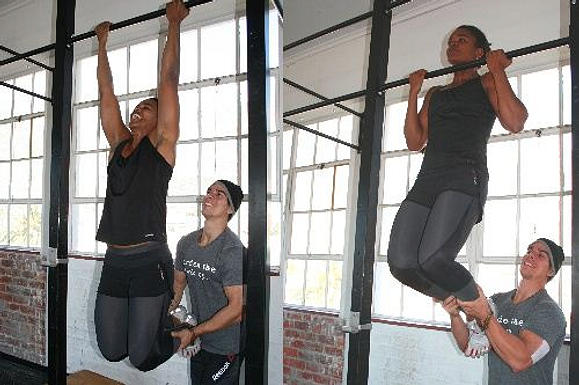
In this version, a partner helps you through the movement. It improves grip and builds strength in your back and arms.
Steps To Follow:
- Hang from the bar with your arms straight. You can bend your knees and cross your ankles.
- Ask your training partner to gently support your lower back, hips, or bent legs to help with the upward movement.
- Have your partner give only as much help as you need to move up and down.
4. Assisted PullUps With Chair
This assisted pullups exercise helps build strength in your back muscles. Use only as much leg push as you need, and focus on pulling with your upper body.
The closer the chair is to your body, the easier the exercise. Use a sturdy chair that won’t tip or slide. As you progress, move the chair so your legs do less of the work.
Steps To Follow:
- Place a sturdy chair under the pullup bar.
- Grip the bar and rest one foot on the chair, with your arms straight.
- Pull your body up as high as you can.
- If you can’t go any further, press off the chair with your foot.
- Lift your body so your chin is slightly higher than the bar.
- Slowly come back to the starting position.
- Then switch legs.
5. Machine pullups
This version works your upper body muscles while the machine takes some of your weight. Select a counterweight that suits you. On an assisted pullup machine, more counterweight means more help, which makes the workout easier.
Steps To Follow:
- Stand in front of the assisted pull-up machine.
- Grip the handles with an overhand grip slightly wider than your shoulders.
- Step or kneel onto the platform.
- Pull your body up until your chin is slightly higher than your hands.
- Slowly come back down to the starting position.
Add these exercises to your strength-training routine. A common starting point is 2 to 4 sets of 8 to 12 repetitions, using enough assistance to finish each set with good form.
Benefits of assisted pullups
Assisted pullups build strength and help you learn proper form and posture.
Regular pullups are hard, but these variations train the same muscles, including the latissimus dorsi (lats), rhomboids, rear shoulders, and biceps. Assisted pullups can also help with:
- building grip strength
- improving your stability
- better posture
They also count toward the muscle-strengthening activity adults need on 2 or more days a week. If you have a shoulder, elbow, or back injury, check with a doctor or physical therapist first.
HP Thoughts: Good breathing control helps with strength exercises like these. Read our post to learn how yoga can help you build it: Yoga Poses.
Conclusion:
Pullups are a great exercise, but they are hard to do. Assisted pullups help you build strength, keep good form, and improve posture along the way.
You can add them to your regular routine. Assisted pullups can be done with bands, machines, a partner, or a chair.
Sources
- 4 Moves to Help You Master the Pull-up, American Council on Exercise
- Adult Activity: An Overview, CDC