Parkinson’s Disease Symptoms, Causes, Diagnosis & Treatment
Contents
- Causes Of Parkinson’s disease
- Parkinson’s disease Symptoms
- 1- Tremors
- 2- Bradykinesia (Slowed movements)
- 3- Loss of automatic movements.
- 4- Postural Changes
- 5- Writing Changes
- 6- Muscle Rigidity
- 7- General:
- How to Diagnose the Disease?
- PET or SPECT
- Treatment of Parkinson’s disease
- Levodopa-Carbidopa Combination
- Dopamine Agonists
- Monoamine Oxidase Inhibitors
- Catechol-O-Methyltransferase Inhibitors
- Anti Cholinergic
- Amantadine
- Surgical Options
- Conservative Treatment for Parkinson’s disease
- Physiotherapy
- Speech Therapy
- Occupational Therapy
- Multidisciplinary Team
- How to Prevent the Disease?
- STAGES
- First Stage
- Second Stage
- Third Stage
- Fourth Stage
- Fifth Stage
- Disease Prognosis
- The Final Verdict:
- Sources
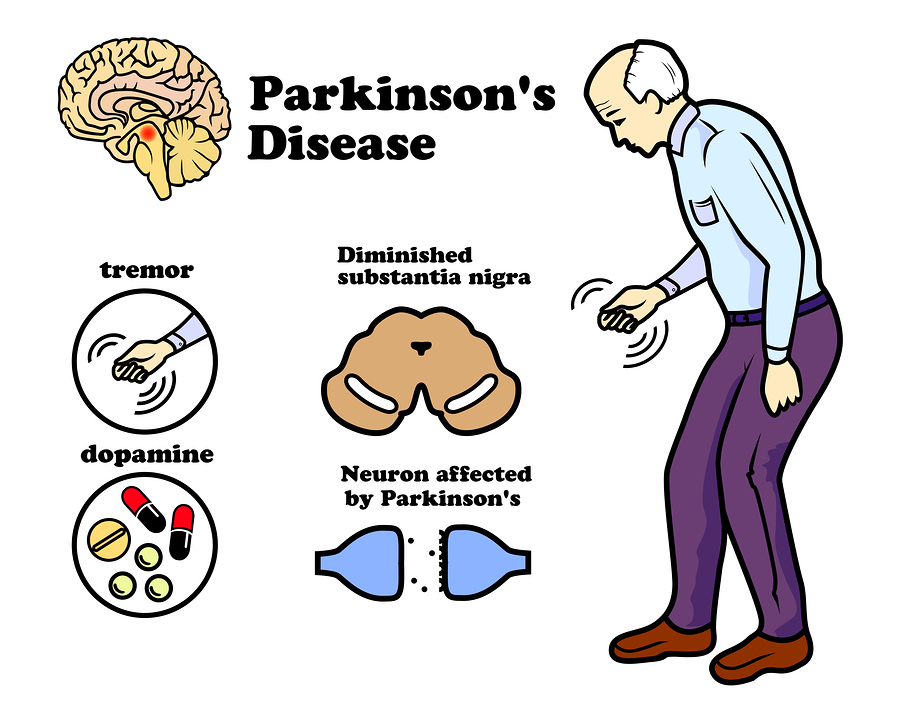
Parkinson’s disease is a progressive neurological disorder that affects body movements. It is caused by the gradual loss of nerve cells in the substantia nigra, a part of the brain that makes dopamine.
Dopamine is a chemical messenger that helps the brain control smooth, coordinated movement. When dopamine-making cells die, movements become slow, stiff and harder to control. The process is slow, and a large share of these cells is already lost by the time symptoms appear.

Parkinson’s disease is marked by tremor, slowness of movement, stiffness and problems with balance. Most cases have no single known cause. Genes play a role in a minority of people, and having a close relative with Parkinson's raises the risk somewhat.
It mostly affects older people, and why the nerve cells die is still being studied. Doctors diagnose Parkinson's mainly from symptoms and a physical exam. There is no cure, but medicines and therapy can improve symptoms for many years.
Causes Of Parkinson’s disease
The exact cause of Parkinson’s disease is not known, but both genes and the environment seem to play a part. The symptoms come from low dopamine levels in the brain as dopamine-producing cells are lost. Other conditions, such as some medicines, strokes or head injuries, can cause similar symptoms (called parkinsonism).
Age: symptoms most often begin around age 60. An early-onset form, which is less common, can start before age 50.
Sex: Parkinson's occurs more often in men than in women.
Family history: having a parent or sibling with Parkinson's raises your risk, but most people with the disease have no affected relatives. Inherited (familial) Parkinson's is much rarer than the common form.
Environmental factors: according to Cleveland Clinic, contact with pesticides or long-term exposure to metals like manganese may raise risk.
Head injuries: repeated or serious head injuries have been linked with a higher risk in some studies.
Parkinson’s disease Symptoms
Parkinson’s disease symptoms vary from patient to patient and progress gradually. They often start on one side of the body and later affect both sides.
Parkinson’s disease signs and symptoms include:
1- Tremors
Tremors often start in a limb, mostly your fingers or hands. The typical Parkinson's tremor happens at rest and eases when you use the hand. Not everyone with Parkinson's has a tremor.
2- Bradykinesia (Slowed movements)
The second main symptom of Parkinson’s disease is slow movements which develop gradually and make your simple tasks difficult. This slowness in your body movements is too much time-consuming. The patient walks on short steps, writes slowly, eats slowly, and even unable to get out of a chair easily. The reason for this slowness in movements is due to the depletion of dopamine neurotransmitter which controls the body movements in a balanced way.
3- Loss of automatic movements.
Unconscious movements such as blinking, smiling and swinging your arms when you walk become less frequent.
4- Postural Changes
Your posture may become stooped, and balance problems can lead to falls.
5- Writing Changes
You may have difficulty to write and your writing become smaller.
6- Muscle Rigidity
Muscle stiffness (rigidity) can occur in any part of the body. It can be painful and may limit your range of motion.
7- General:
The face may look less expressive, and speech can become soft or monotone. Many people have a reduced sense of smell, anxiety, depression, constipation and sleep problems, sometimes years before movement symptoms. Handwriting may become very small (micrographia), and tying shoelaces or buttoning clothes can become hard.
Memory and thinking problems, including dementia, can develop, usually later in the disease. Other problems can include fatigue, daytime sleepiness, sexual problems, drooling, swallowing trouble, dizziness on standing, weight loss and bladder problems.
How to Diagnose the Disease?
Parkinson's disease is usually diagnosed by a neurologist, ideally one who specializes in movement disorders. When you see your doctor, he will ask you about certain questions like
- when did the disease begin?
- do you suffer any dementia?
- what is the type of your tremors?
- for how long the tremors last?
- do you suffer any memory problems?
- are there slowing of movements?
- do you feel rigidity while you move your limbs?
- is your walking posture changed?
After asking these questions, the doctor will examine you. There is no single test that confirms Parkinson's, so the diagnosis is mainly clinical. Tests are used to rule out other conditions.
- CT scan
- A CT scan is usually normal for age and is not very helpful for diagnosing the disease.
- MRI
MRI is usually normal in Parkinson's disease. It helps rule out other causes, such as strokes or other brain changes.
PET or SPECT
A special SPECT scan called a DaTscan can show reduced dopamine activity, even early on. It is needed only in some cases, and it cannot always tell Parkinson's apart from related disorders. Genetic testing
Genetic testing may be offered when Parkinson's starts at a young age or runs in the family.
Treatment of Parkinson’s disease
There is no cure, but medicines can control many symptoms. The most effective drug is levodopa combined with carbidopa. Other drug groups, such as dopamine agonists and MAO-B inhibitors, are also used. Treatment usually starts when symptoms begin to interfere with daily life. Your neurologist will choose and adjust medicines, as doses often need changing over time.
Levodopa-Carbidopa Combination
The combination of levodopa and carbidopa is the mainstay of treatment. It works especially well for slowness and stiffness. Levodopa is turned into dopamine in the brain. Carbidopa blocks levodopa from being converted to dopamine in the rest of the body before it reaches the brain. This lets more levodopa reach the brain and reduces side effects such as nausea.
Dopamine Agonists
Dopamine agonists mimic dopamine in the brain. They are less effective than levodopa and can cause side effects such as sleepiness, hallucinations and impulse-control problems. Non-ergot agonists such as ropinirole and pramipexole are preferred over older ergot types such as bromocriptine and cabergoline.
Monoamine Oxidase Inhibitors
MAO-B inhibitors such as selegiline and rasagiline block an enzyme that breaks down dopamine in the brain, so dopamine lasts longer.
Catechol-O-Methyltransferase Inhibitors
They prevent the breakdown of levodopa and they extend the duration of action of levodopa.
Agents: entacapone, tolcapone
Anti Cholinergic
These drugs can help tremor and rigidity, but they have many side effects, such as constipation, dry mouth and confusion. They are usually avoided in older adults.
Agents: benztropine, trihexyphenidyl
Amantadine
Amantadine can ease mild symptoms and reduce involuntary movements (dyskinesia) caused by levodopa. Side effects can include ankle swelling, confusion and hallucinations.
Surgical Options
Deep brain stimulation (DBS) uses implanted electrodes to send electrical pulses to parts of the brain that control movement. The usual targets are the globus pallidus and the subthalamic nucleus. DBS is mainly for people whose symptoms are no longer well controlled by medicines. It can ease symptoms but does not cure the disease.
Conservative Treatment for Parkinson’s disease
Physiotherapy
Physical therapy is an important part of treatment at every stage. It can improve balance, flexibility, strength and walking, and helps reduce falls.
Speech Therapy
Speech therapy can help soft speech and voice problems (dysarthria and dysphonia), and it can help with swallowing. Being able to communicate well also supports mood and quality of life.
Occupational Therapy
Occupational therapy helps with everyday tasks, such as dressing, bathing and using the toilet, and can recommend helpful equipment.
Multidisciplinary Team
The patient of Parkinson’s should be treated with a multidisciplinary team which includes nurses, PD Specialists, neuropsychiatrist and neuro physicians.
How to Prevent the Disease?
There is no proven way to prevent Parkinson's disease. Regular exercise and a healthy diet are good for overall health and are being studied for a possible protective effect. There is no routine screening test for Parkinson's, so talk to a doctor if you notice early symptoms, especially if the disease runs in your family.
STAGES
Doctors often describe Parkinson's in five stages (the Hoehn and Yahr scale). The disease progresses at a different pace in each person.
First Stage
In stage 1, symptoms are mild and usually affect only one side of the body.
Second Stage
In stage 2, symptoms become more noticeable and affect both sides of the body.
Third Stage
Stage 3 is the middle stage. Balance problems and falls become more common, and symptoms cause mild to moderate disability, but many people can still live independently.
Fourth Stage
In stage 4, symptoms are severe and limit most activities. People usually need help with daily tasks, and living alone is often unsafe.
Fifth Stage
Stage 5 is the most advanced stage. People need full-time care and help with all daily activities, and they may need a wheelchair or be confined to bed.
Disease Prognosis
Parkinson's can lead to complications such as falls, swallowing problems and infections, which affect quality of life. Falls can cause head injuries and broken bones.
Treatment cannot stop the disease from progressing, but starting the right treatment at the right time can greatly improve quality of life.
HP Thoughts: Neurological diseases wreak havoc on the individual because of physical incapacitation. The person afflicted is no longer capable of full control of his or her body and has partial or complete loss of one or all motor skills. Here is another example of this type of disorder: Epilepsy.
The Final Verdict:
Parkinson’s disease is caused by the loss of dopamine-producing nerve cells in the brain pathways that control movement. Dopamine is one of the main neurotransmitters in the brain, and when it falls, the signs and symptoms of the disease appear. If you notice a tremor at rest, slower movements, smaller handwriting or a less expressive face, see your doctor.
Medicines do not stop the disease from progressing, but they can ease symptoms and help you stay active for longer. A neurologist should guide treatment.
Sources
- Parkinson disease, MedlinePlus (U.S. National Library of Medicine)
- Parkinson's Disease: What It Is, Symptoms & Treatment, Cleveland Clinic
- Parkinson's Disease Stages, Cleveland Clinic