Back Piercing: How It's Done, Aftercare and More
Contents
Love the look of back dimples but don’t have them naturally? A back piercing is one way to highlight that area. It is usually called a back dimple piercing, and it is also known as a Venus piercing.
Back Piercing
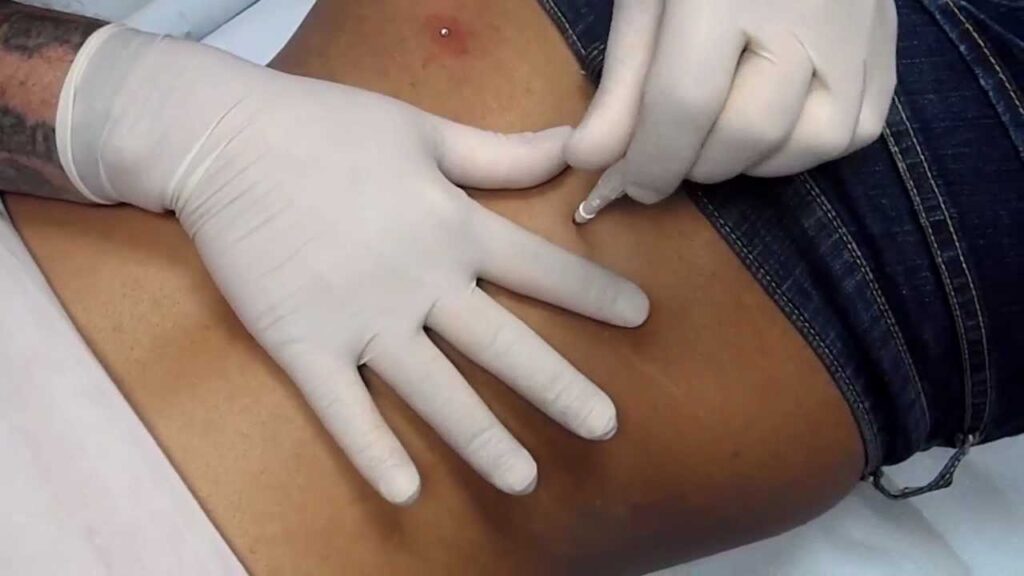
Back dimple piercings are different from most piercings. They are usually done as dermal piercings. A needle or a small punch tool is used to make a pocket in the dermis, the middle layer of the skin.
Using forceps, the piercer inserts an anchor with a post into the pocket. Finally, they screw a decorative jewelry “top” onto the post.
Many people like how a back piercing accents the curves of the lower back. If you already have dimples, the jewelry draws attention to them.
How To Do Back Piercing
A dermal piercing is not like a traditional piercing. It has a single point in the skin, instead of the entry and exit holes of a traditional piercing.
For a back dimple piercing, an anchor is placed in the dermis so the jewelry sits on the lower back, just above the buttocks.
Method:
A back piercing usually follows these steps:
- The piercer will ask for your ID and have you fill out paperwork.
- You’ll go to a private room where the piercer checks the area.
- The piercer cleans and disinfects the skin.
- They mark the spots to be pierced with a body-safe marker.
- They pierce the first spot and insert the jewelry, then repeat on the second side.
- They clean up any blood and disinfect the area again.
- Finally, they give you aftercare instructions to follow.
Pain Level:
To be honest, it will hurt. How much depends on you, since everyone’s pain level and tolerance are different. Your lower back may feel sore for a few days afterward.
Learn as much as you can about back piercings before you visit a studio. A skilled piercer can make the process quick and as comfortable as possible, but no piercing is completely painless.
Jewelry of piercing:
The most common choice is an anchor with a top, because the tops are interchangeable. You don’t need to remove the anchor to change the look.
The second option is a diver. Divers are placed with a different method:
A diver has a pointed base that sits under the skin and a decorative top. It is inserted into a hole in the tissue, which is made with a tool called a “Skin Punch“.
A skin punch is a sharp, hollow tool that removes a small circle of tissue. The diver is then inserted into the resulting hole.
This method can cause less bleeding. But a diver’s top can’t be swapped, so you’re limited to the jewelry you start with.
Material Options:
The Association of Professional Piercers (APP) recommends using only high-quality, body-safe materials for new piercings, such as:
- Implant-grade titanium.
- Niobium.
- Implant-grade steel.
- 14-karat or higher solid gold that is nickel-free.
Gold-plated, gold-filled, and gold vermeil jewelry is not suitable for a fresh piercing.
How Much It Costs?
Prices vary widely depending on the studio, the piercer’s experience, and your location. The piercing fee often doesn’t include the jewelry, which can add to the cost depending on the material. Ask for a full price quote before you book.
Effects Of Back Piercing:
Back dimple piercings carry real risks. These include infection, allergic reactions to the jewelry, scarring (including raised keloid scars), and tissue damage. Unsterile equipment can spread infections such as hepatitis.
Dermal anchors can also shift (migrate) or be pushed out by the body (rejected), especially if they get bumped or snagged on clothing. Healing takes time, often a few months, and can take longer for some people.
Aftercare Of Back Piercing:
A dermal piercing needs ongoing care for as long as you wear it, because it can snag or get irritated. Follow the instructions your piercer gives you after the piercing.
- Wash your hands before touching the area.
- Clean the piercing with a sterile saline solution.
- Avoid harsh soaps and other products that can irritate the piercing.
- Pat the area dry with a clean paper towel or towel.
- Avoid putting pressure on the area.
- Use clean bedsheets.
- Wear loose, comfortable clothes that won’t rub or snag.
- Don’t touch, twist, or move the jewelry.
See a doctor if you notice spreading redness, warmth, swelling, pus, fever, or red streaks around the piercing. These can be signs of infection.
Interchange Of Jewelry:
Don’t try to change the jewelry until the piercing has fully healed. Doing so too early can cause pain, irritation, and damage to your skin. Ask your piercer to do it for you.
Conclusion:
Everyone is beautiful, and you don’t need a piercing to prove it. But if you want back dimple piercings, it helps to know what they involve. They are done by placing small anchors in the skin just above the buttocks.
Choose an experienced piercer and a clean studio that properly sterilizes its equipment. Take good care of the piercing afterward; without proper care, it can cause pain, irritation, and infection.
Sources
- Piercing and Tattoos, MedlinePlus
- Jewelry for Initial Piercings, Association of Professional Piercers